
Temple
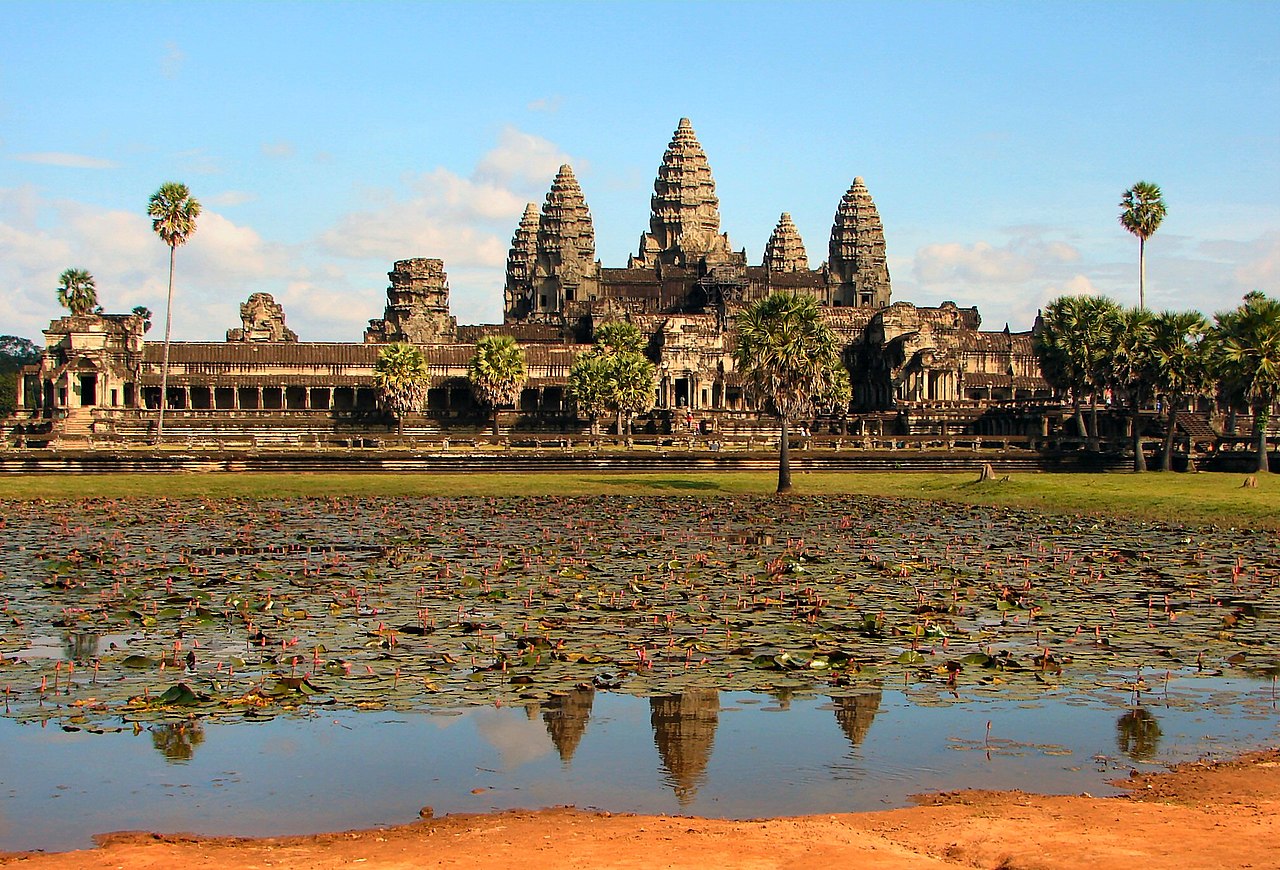
Angkor Wat sunrise
Leave town at 5 a.m. in the dark and watch the five towers materialise from the reflection pool as the sky goes from black to rose to gold — the most powerful dawn in Southeast Asia.
City of the God-Kings
Siem Reap wears its UNESCO crown lightly — beyond the vast Angkor complex, the town is full of good restaurants, good-natured tuk-tuk drivers, and the kind of easy warmth that makes first-time visitors stay a week longer than planned.
Leave town at 5 a.m. in the dark and watch the five towers materialise from the reflection pool as the sky goes from black to rose to gold — the most powerful dawn in Southeast Asia.
Two hundred stone faces of the Bodhisattva Lokesvara smile from 54 towers in the exact centre of Angkor Thom. Early light makes them otherworldly.
Silk-cotton and strangler fig trees have swallowed the walls of this 12th-century monastery — their roots grip carved doorways like enormous fingers, intentionally left by UNESCO as found.
The causeway approach to the walled city's south gate is flanked by 54 gods and 54 demons pulling on a naga serpent — one of the most theatrical entrances in world architecture.
An hour north of the main complex, this tenth-century temple of rose-red sandstone is carved with such precision that archaeologists once assumed it was made in miniature and then enlarged.
The hill temple that predates Angkor Wat commands a panorama over the entire plain — the view of Angkor Wat's towers at eye level is impossible to photograph adequately.
Stilted houses rise ten meters above the flooded forest depending on the season, a fishing community built entirely around the pulse of the Tonle Sap. A slow boat glide reveals a Cambodia unrelated to temple ruins.
A sprawling 12th-century monastery the size of a small town, with long columned corridors, collapsed galleries, and far fewer visitors than the Grand Circuit staples.
Southeast Asia's largest freshwater lake, ringed by floating villages where stilted houses rise six metres between wet and dry seasons — a boat tour through the channels explains the extraordinary hydraulics.
An air-conditioned sanctuary of Khmer sculpture and scale models that fills in historical context missing from temple signage — visit before or after the complex, never during.
A covered market of silk scarves, stone carvings, silver jewellery, and spice bundles — the tourist section is upfront, but wade into the local food stalls at the back.
An hour east of Siem Reap, this massive temple has been deliberately left largely unrestored — stones tumble, trees push through walls, and you pick your own path through the ruins.
A social-enterprise silk workshop employing local craftspeople in traditional techniques — free to tour, and the showroom sells genuine hand-woven products at transparent prices.
A jungle trail follows a stream upriver to a stretch of sandstone carved with thousands of Hindu lingas and reclining deities, worn smooth by centuries of running water. The forest canopy keeps the afternoon walk cool.
The temple carvings come to life: Khmer classical dancers in gilded headdresses perform the gestures depicted on Angkor's bas-reliefs, accompanied by a traditional pinpeat orchestra.
Siem Reap's famous strip is genuinely fun rather than merely notorious — start with a happy-hour cocktail at Asana Wooden House and follow the music.
A local guide takes you through six stops in a tuk-tuk: fried crickets, fish amok from a family kitchen, nom banh chok noodles, and a sugarcane juice cart to finish.
The infinity-pool rooftop at Jaya House River Park overlooking the lit-up Old French Quarter — free-pour cocktails, barefoot, as the rickshaws circle below.
Young performers trained by a social enterprise circus school tell contemporary Cambodian stories through acrobatics, live music and theatre under a big top on the edge of town. It is equal parts spectacle and social impact, with proceeds funding arts education.
Away from the sunrise crowds, the temple's reflection in its broad moat turns molten as the sky colours over. It is the same silhouette everyone photographs at dawn, seen instead in a quieter, gentler light.
Phnom pleung, or 'hill of fire', lets diners grill their own marinated meats and vegetables over a tabletop charcoal mound while soup simmers in the moat around it. It is Cambodia's answer to hot pot, best shared.
Twenty-four suites inside King Sihanouk's former villa on the road to Angkor — private guided temple access at dawn and dinners served inside illuminated temple complexes after dark.
A 1932 colonial landmark with shuttered corridors, an outdoor pool framed by frangipani and a legacy of hosting monarchs — the Elephant Bar remains Siem Reap's most civilised sundowner.
Park Hyatt's zen-minimalism translates beautifully in Siem Reap: French-Colonial buildings wrapped around a reflective courtyard pool and a world-class Cambodian cooking studio.
A low-rise heritage garden retreat on the Siem Reap riverbank with wood-and-stone suites, private terraces and a saltwater pool — the most romantically understated address in town.
Rates change — check the live price.
Photography shows the dishes and cuisine — representative, not from the restaurants themselves.
A Khmer tasting menu that changes weekly with the market — the single best argument that Cambodian cuisine deserves international respect.
Family recipes from the region, presented beautifully — fish amok, green mango salad, and Khmer red curry made to a grandmother's standard.
A strip of outdoor grills near the night market where you cook your own meats and vegetables over a tabletop charcoal bucket — extremely local, extremely fun.
A training restaurant for at-risk youth — the Cambodian and Western food is genuinely good, the iced-coffee excellent, and the garden a relief from the heat.
Possibly the best air-conditioning in town alongside good espresso and a white-cushioned upper floor perfect for escaping midday heat.
Cambodian-inspired cocktails in a beautifully restored wooden house — the lemongrass mojito and pandan sling are the best things on Pub Street.
A one-day pass is $37, three-day $62, seven-day $72 — if you have three or more days in Siem Reap, the three-day pass is almost always the right call.
A single driver for your entire stay (around $15–20 per day) who learns your pace and interests is worth far more than hailing strangers — ask your hotel for a recommendation.
The reflection-pool sunrise crowd is real and growing — stake your position on the north pond causeway by 5:15 for an unobstructed view.
Shoulders and knees must be covered at all Angkor sites; guards enforce the rule at the ticket check. A lightweight sarong solves the problem quickly.
The Angkor plain is exposed and hot year-round — carry at least 1.5 litres of water per person for a full temple day, and refill at the market stalls inside the complex.


