Giant Panda Research Base at opening
Arrive at 7:30 a.m. when the pandas are active and feeding — the nursery enclosures and outdoor eucalyptus groves give genuinely close encounters with sub-adults that the midday crowds never see.
Slow Fire, Hot Wok
Chengdu moves at a pace that makes every other Chinese megacity seem exhausted — teahouses full at 2 p.m. on a Tuesday, mahjong echoing from courtyard hutongs, and a food culture so deeply rooted that UNESCO declared it a Creative City of Gastronomy.
Arrive at 7:30 a.m. when the pandas are active and feeding — the nursery enclosures and outdoor eucalyptus groves give genuinely close encounters with sub-adults that the midday crowds never see.
A Chengdu institution where retired locals play mahjong, argue, and have their ears cleaned by professional ear-pick artists — order green tea, settle into a cane chair, and don't rush.
The memorial temple to Three Kingdoms statesman Zhuge Liang is one of the most revered sites in Sichuan — the cypress-shaded courtyards and stone inscriptions reward a slow morning walk.
One of Taoism's four sacred mountains, an hour from Chengdu by high-speed rail — forest trails past ancient monasteries with mist threading through the bamboo canopy.
A 2,300-year-old engineering marvel still watering the Chengdu Plain — the fish-mouth levee and the connected Erwang Temple above the Min River make a fascinating and rarely crowded morning.
The memorial park on the site of Tang-dynasty poet Du Fu's hermitage — bamboo groves, lotus ponds, and calligraphy halls in a landscape that still feels meditative despite its central location.
Chengdu's oldest and largest Taoist temple, Qingyang Palace pairs incense-wreathed halls with a garden of ancient ginkgo trees, best explored in the stillness of a morning visit.
The 71-metre Tang-dynasty cliff Buddha is the world's largest stone Buddha — take the boat for the full frontal view and then queue for the steep cliff stairs to stand level with his enormous toes.
The restored Qing-dynasty courtyard lanes of Wide and Narrow Alley host the city's most performative teahouses — shadow puppet shows, face-mask artists, and the best place to spend a slow afternoon.
Learn to blend the mala base from scratch using dried chillies, Sichuan peppercorns, fermented doubanjiang, and tallow — then eat what you made with a classful of strangers.
The restored Han-dynasty merchant street adjacent to Wuhou Shrine — red lanterns swing above rows of snack vendors selling rabbit-head skewers, tangyuan, and iced jelly in the afternoon sun.
The state-of-the-art civic museum beside Tianfu Square holds extraordinary Sichuan-specific collections — the Three Kingdoms military artefacts and the Sanxingdui bronzes context gallery are exceptional and free.
The largest surviving Buddhist temple in Chengdu operates a thriving vegetarian restaurant and an antiques market in the surrounding lanes — the incense braziers are lit from early afternoon.
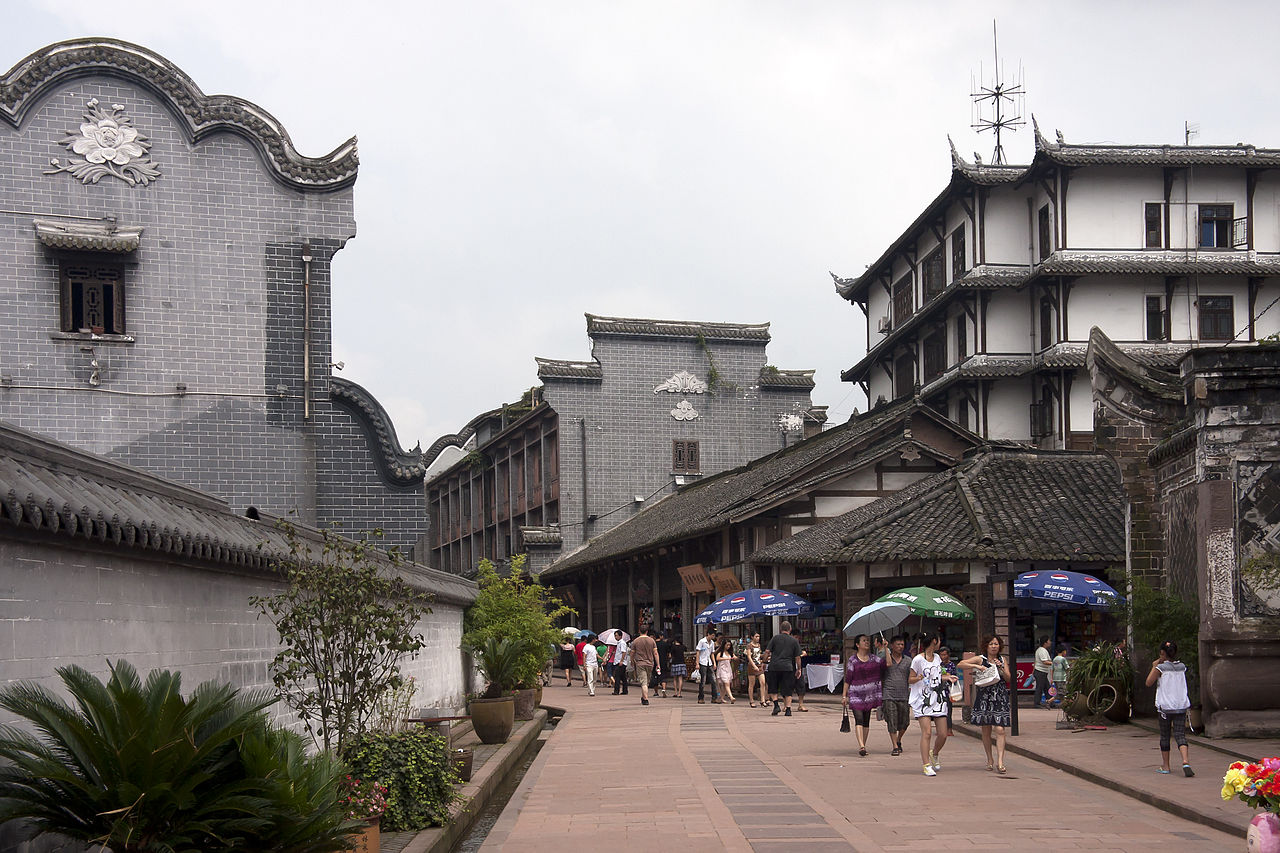
Settled by Hakka migrants centuries ago, this walled town outside Chengdu still speaks its own dialect, and an afternoon among its guildhalls and lantern-strung lanes offers a different side of Sichuan life.
Shufengya or the Jinsha Theatre hosts the full Sichuan opera programme including fire-breathing, shadow puppetry, and the jaw-dropping bian lian face-changing artistry — book the teahouse seats for the best view.
Ordering individually at a communal cauldron of mala broth — tripe, lotus root, duck intestine, and tofu skin alongside whatever the table votes for. The noise and heat are fully part of the experience.
After the afternoon crowds thin, the lanterns along Jinli come fully into their own — photographers chase the red reflections in the cobblestones and street performers work the cooling night crowd.
Sichuan produces some of China's finest liquor, from the floral grain spirit of Luzhou Laojiao to the sauce-aroma style of Guotai — a guided flight at a dedicated tasting bar cuts through the intimidating label wall.
This reconstructed covered bridge glows above the Jin River each evening, its reflection rippling alongside the willow-lined banks of one of Chengdu's most photographed corners. It costs nothing and rewards even a short detour.
Local musicians play erhu and pipa between rounds of tea in an old-style teahouse, sometimes joined by a quick-change Sichuan opera performer between sets. It is a slower, more intimate cousin of the city's bigger opera shows.
Chengdu's central shopping district turns into a grazing ground after dark, its side streets thick with skewers, rabbit head and cold noodles sold from lantern-lit carts. It is best tackled with an empty stomach and no fixed plan.
A sleek riverside tower above the Nan He with sky-high pool, Michelin-recognised Cantonese dining and butler-attended river-view suites overlooking the Sichuan skyline.
A restored cluster of Qing dynasty workshops woven into Chengdu's chicest retail district, anchored by a lantern-lit spa and a tea-ceremony butler service.
The city's grandest address anchors Chengdu's Hi-Tech Zone with a soaring atrium, platinum-level butler service and a rooftop terrace surveying the heart of Sichuan.
Hong Kong-bred luxury label brings bespoke Italian linens, a glass-enclosed infinity pool and a Sichuan-fusion rooftop bar to Chengdu's gleaming financial district.
Rates change — check the live price.
Photography shows the dishes and cuisine — representative, not from the restaurants themselves.
Chengdu's most quietly revered Michelin-starred table — the cold rabbit in house-ground chilli oil and the slow-braised pork in aged doubanjiang distil decades of Sichuan scholarship into each perfect bowl.
Old Chengdu hotpot atmosphere in a Qing-dynasty courtyard — the tallow-based mala base is properly fierce and the service pace is refreshingly unhurried.
The 150-year-old original mapo tofu restaurant — silken bean curd in numbing crimson broth unchanged for generations. Go at lunch to avoid dinner queues.
Sweet-soy-glazed boiled dumplings that split the difference between savoury and dessert — eight pieces at a wooden counter for about 15 ¥.
The teahouse and the city are inseparable — a pot of Dragon Well, a plate of melon seeds, and an afternoon in a cane chair that has never been hurried.
W Hotel's boundary-pushing all-day restaurant reimagines Sichuan canon — mapo tofu arrives with lobster and the bar's signature baijiu highballs draw a polished Taikoo Li crowd deep into the evening.
The Giant Panda Research Base is dramatically less crowded and the animals are active before 9:30 a.m. — get there by 7:30 a.m. for the best encounters.
Chengdu's mala numbing heat is cumulative — ask for wei la (slightly spicy) at first and work up; there's no shame in it and the flavour is still excellent.
Chengdu has gone almost entirely cashless, including small teahouses and night market vendors — set up WeChat Pay with an international card or carry ¥500 in small bills as backup.
Leshan and Dujiangyan are both under 90 minutes by bullet train from Chengdu East or North — buy tickets on the Trip.com app, which accepts foreign cards.
Sichuan's basin traps overcast skies for much of the year — don't plan around blue-sky days. The mist suits temples and panda enclosures better than harsh sunshine anyway.