Heritage
Peristyle at sunrise
The Roman emperor's ceremonial courtyard is still the social heart of the city; at 07:00 it belongs to the cats and a handful of early risers before the espresso bars roll up their shutters.
Grad Živih Zidova
Split is the only city in the world where people still live, eat, and argue inside a Roman emperor's retirement palace — and then walk five minutes to a catamaran that takes them to some of the most beautiful islands on the Adriatic.
The Roman emperor's ceremonial courtyard is still the social heart of the city; at 07:00 it belongs to the cats and a handful of early risers before the espresso bars roll up their shutters.
The limestone ridge behind Split offers views from the Dalmatian islands to the Bosnian ranges; the trail from Koprivno gains 700 metres with no technical difficulty and rewards generously.
A Roman mausoleum converted into a Christian cathedral — climb the Romanesque bell tower for the most satisfying aerial view of the old city's extraordinary Roman bones.
Twenty minutes west, the island town of Trogir is entirely UNESCO-listed; arrive early for the Romanesque portal of the Cathedral of St. Lawrence before coaches begin to appear.
The open-air market spills from the eastern gate of Diocletian's Palace every morning — figs, lavender honey, olive oil, and burek from the adjacent bakeries that open at dawn.
The earliest catamaran reaches Hvar Town in 65 minutes; arriving early means the medieval streets and the hilltop fortress before the island fills with the yacht and speedboat crowd.
Just outside Split, the sprawling ruins of ancient Salona, once the capital of Roman Dalmatia, include an amphitheatre, basilicas, and a necropolis half-swallowed by cypress trees. Morning light and few visitors make it an easy contrast to the packed Riva.
The 16th-century Spanish fortress above Hvar Town commands one of the most sweeping island views on the Adriatic; the island's lavender fields peak in late June and scent the whole climb.
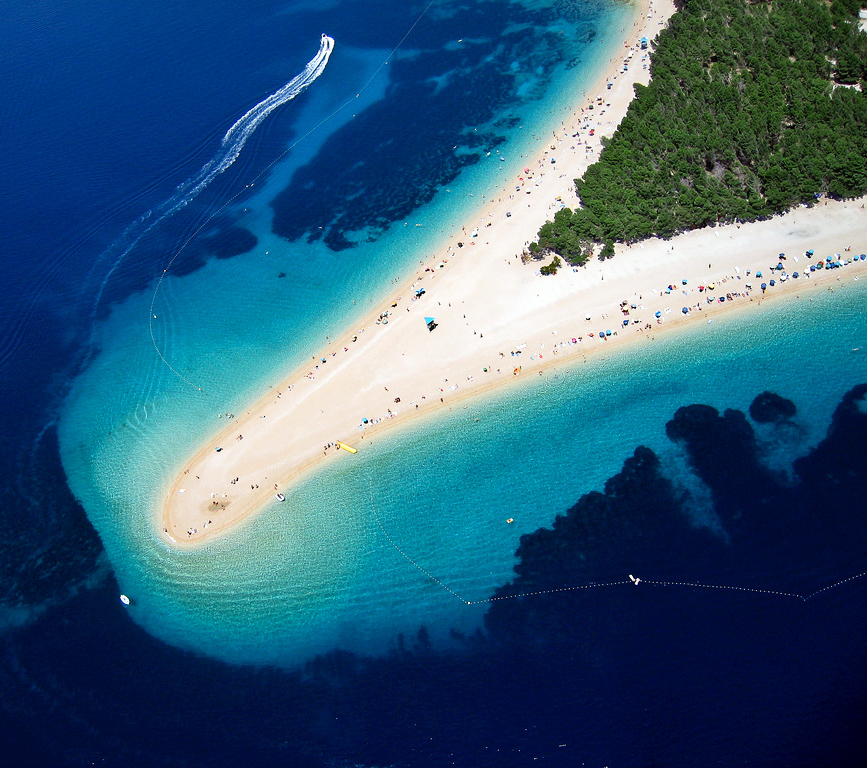
Croatia's most photographed beach: a white-pebble spit that visibly shifts direction with the prevailing current, jutting into water that grades from jade to deep cobalt.
The glass-bottomed U-shaped platform overhangs the limestone massif above Makarska — the Adriatic islands appear as a scattered map 1,200 metres directly below your feet.
Guided speedboat to the islet of Biševo's Blue Cave, where noon sunlight refracts to fill the entire grotto in silver-blue light — timing is everything, and midday is everything here.
Ivan Meštrović built this seafront villa as his personal studio; the collection of bronze and marble sculpture is monumental in every sense, set in a garden terrace above the sea.
The mountain citadel that guarded Split's hinterland for millennia — and served as Meereen in Game of Thrones. The views down to the islands are a strong secondary reward for the drive.
A sandy, shallow cove just steps from the old town, Bačvice is where Split comes to swim, play picigin in the surf, and linger at the beachfront cafés. It is as much a local institution as a beach.
The pine-covered peninsula west of the old town has a series of viewpoints over the islands and Kaštela bay; the western tip gets the full sunset show and costs absolutely nothing.
The palm-lined promenade in front of Diocletian's south wall is the Dalmatian passeggiata in its fullest expression — join the parade with an ice cream and no particular destination.
The best konobe are tucked inside the actual Roman walls — stone tables, peka lamb slow-baked under the bell, and local Pošip white wine poured in ceramic jugs.
The underground bar scene in Split punches well above the city's size; the old town fills with live music venues from 22:00 onward and stays lively well past midnight.
The vast substructures beneath the palace, used for centuries as a market and dump before excavation, take on an entirely different mood by lamplight, echoing and half-lit.
A small selection of Dalmatian reds and whites poured within the ancient walls themselves, the stone vaulting doing most of the atmospheric work.
A slow evening sail past Split's outer islands, timed so the return leg into harbour coincides with the sky turning from orange to indigo behind the palace skyline.
Built within the walls of Diocletian's actual vestibule, a UNESCO Roman ruin, Vestibul Palace's seven bespoke suites make it the only hotel on earth where you literally sleep inside a 1,700-year-old imperial throne room.
A Habsburg-era palazzo commanding Hvar's celebrated main piazza and harbour, Palace Elisabeth's restored Art Nouveau interiors, a signature pool, and access to Hvar's lavender-scented hilltop fortress create the island's most distinguished address.
Hvar Town's sleekest contemporary address, where a rooftop infinity pool overlooks the entire harbour, a world-class thalasso spa utilises Adriatic seawater, and a curated wine list accompanies a seafood menu of extraordinary freshness.
Split's most refined city hotel occupies a landmark building steps from the Peristyle, its rooftop infinity pool and suites clad in local stone and oak offering a polished urban-luxury counterpoint to the ancient city below.
Rates change — check the live price.
Photography shows the dishes and cuisine — representative, not from the restaurants themselves.
Creative Dalmatian tasting menu in vaulted cellars beneath the Peristyle — the octopus peka and black risotto are genuine benchmarks of modern Croatian cooking.
Cliff-side terrace restaurant with grilled whole fish and Cetina-river eel; a proper local institution that survives entirely on word of mouth.
Directly above the fish market; lunch only, and the catch arrives while you eat — order whatever looks freshest on the ice downstairs before you sit.
The wood-fired pizza that Split locals swear by — a queue that moves fast, honest prices, and a dough that has been the local benchmark for decades.
Small gelato shop tucked into the palace walls; fig, lavender, and sea-salt caramel flavours reflect the Dalmatian pantry in miniature.
Split's most stylish wine destination with Domaldova Street's celebrated bottle wall — Pošip, Plavac Mali, and Dingač poured alongside creative small plates, with the bar turning electric after evening service winds down.
Catamarans to Hvar and Vis sell out in July and August — buy tickets on the Jadrolinija website at least a day in advance, not at the dock.
The famous slow-cooked lamb or octopus peka must be ordered a minimum of 24 hours ahead at most konobe — plan dinner the day before, not on the night.
The Roman walls are only a small fraction of Split; Marjan Hill, the Meštrović Gallery, and the green market are equally rewarding with far fewer visitors.
Old Town Split has almost no visitor parking; stay or park in Spinut or Žnjan and walk or take a taxi the last stretch into the centre.
Hvar, Brač, Vis, and Šolta are all reachable within 90 minutes by catamaran — use Split as a flexible base rather than committing to island accommodation.