Museum
Kunsthistorisches Museum opening hour
Arrive at 10:00 to walk the Picture Gallery largely alone — Bruegel's hunters, Vermeer's interiors, and the most complete Cellini salt cellar ever cast.
Kaiserliche Stimmung
The Habsburgs' imperial capital still wears its grandeur lightly — Ringstrasse palaces, world-class museums, and the Wiener Philharmoniker coexist with third-wave coffee bars and a Naschmarkt that smells of cumin and fresh mountain cheese.
Arrive at 10:00 to walk the Picture Gallery largely alone — Bruegel's hunters, Vermeer's interiors, and the most complete Cellini salt cellar ever cast.
The Imperial Tour through the 40-room State Apartments, then a climb through the French gardens to the Gloriette for a panorama over the city toward the Alps.
Scale the South Tower's 343 steps before midday heat for a close-up of the chevron roof tiles and, on clear days, a distant Alpine horizon.
Morning training sessions open to the public let you watch the Lipizzaner stallions move through classical dressage — more intimate than a full evening performance.
Tram and bus to Kahlenberg, then a forest path through beech and oak back toward Grinzing with the city visible through the treetops as you descend.
One of the world's great graphic-arts collections, housing Dürer's Hare alongside rotating blockbusters in a building that doubles as a Habsburg reception suite.
A glass elevator installed inside this baroque church's dome lifts visitors eye-level with its ceiling frescoes, a vantage point unavailable anywhere else in the city. Come soon after opening, when the interior is hushed and the light is soft.
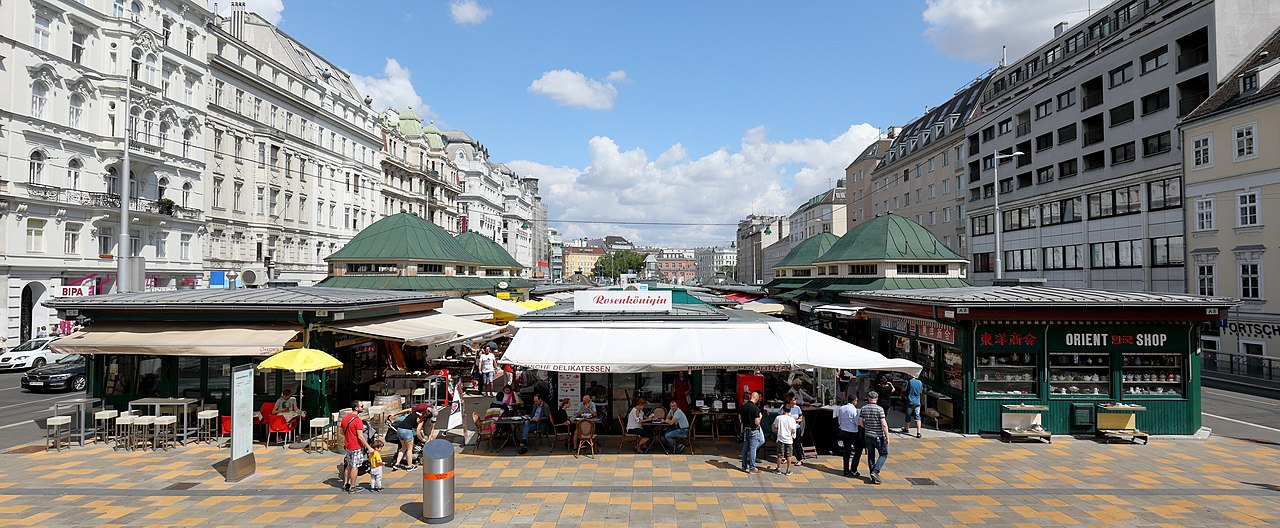
Vienna's kilometre-long open market runs from delis heavy with Styrian pumpkin-seed oil to Turkish pickle barrels and artisan mountain cheese — eat as you walk.
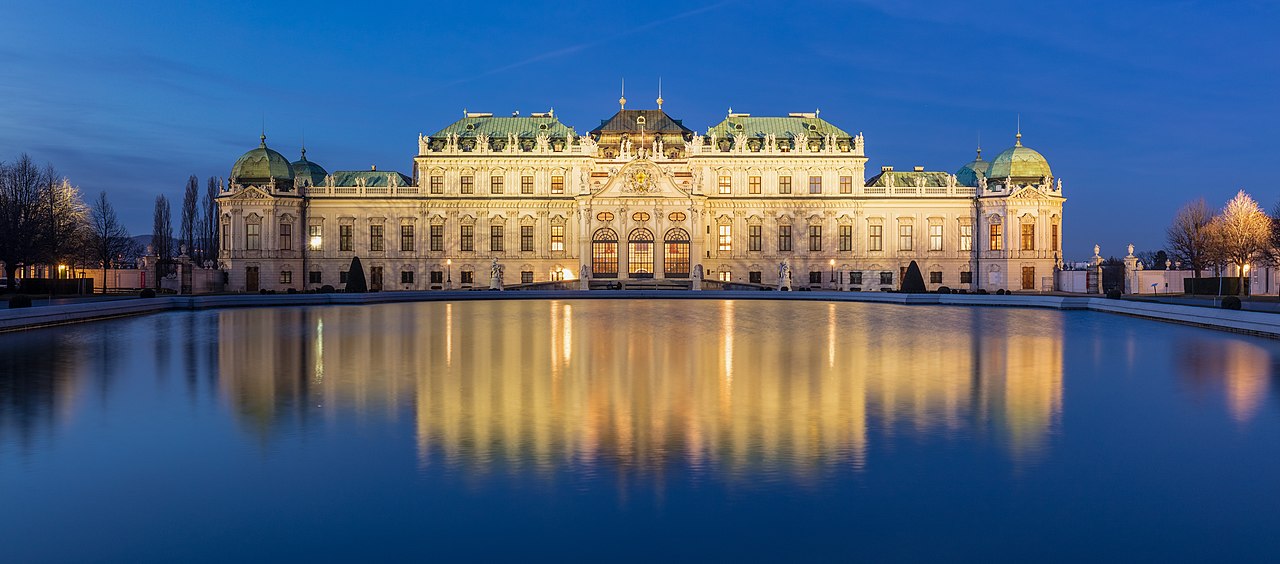
Klimt's The Kiss and Schiele's contorted figures hang in a Baroque palace with formal gardens mirrored in the long central canal below.
The Leopold Museum's Schiele retrospective, MUMOK for contemporary art, then an afternoon espresso in the giant deck-chair-filled main courtyard.
The 1897 giant Ferris wheel revolves slowly enough for a full city panorama, then the chestnut-lined Hauptallee stretches for 4 flat, leafy kilometres.
Sit in a vine-shaded courtyard with cold-cuts and this year's young Grüner Veltliner — the Viennese tradition of the local wine tavern at its most honest.
The 5 km grand boulevard takes in the Parliament, City Hall, Burgtheater, Opera House, and twin natural-history museums in warm afternoon light.
Uneven floors, rooftop trees, and not a straight line in sight define this whimsical apartment block and its adjacent museum, both monuments to an architect who distrusted right angles. It is a playful counterpoint to Vienna's imperial grandeur.
Dress up for the Staatsoper or find a last-minute Volksoper ticket for a fraction of the price — Vienna's musical life spans the ceremonial and the joyfully accessible.
Arched neo-Gothic ceilings, a pianist in the corner, and a Melange that has changed almost nothing since Freud and Trotsky argued over the tables here.
Austria's two-star temple to seasonal mountain produce: slow-cooked Lünersee trout, meadow herbs, and a wine list of encyclopedic Austrian depth.
The O-Linie loops the entire Ringstrasse after dark; ride it twice for one of the world's finest €2 architectural tours under floodlit spires and colonnades.
Vienna's tallest structure spins a slow revolving view over the Danube and the Vienna Woods as the sky turns copper, the city's grid of church spires resolving into silhouette below. Time it right and the descent lands just as the streetlights come on.
Chamber ensembles in period dress perform waltzes and arias in gilded halls lit only by candle, a tradition that has drawn evening audiences to Vienna since well before the tour buses arrived. Expect a Strauss polka encore to send everyone out humming.
A short tram ride from the centre, this vine-covered hillside village keeps its own quieter cluster of wine taverns where the season's young vintage is served alongside cold cuts and pretzel bread. It is Grinzing's less crowded cousin, and locals prefer it that way.
Opposite the State Opera since 1876, the Sacher's legendary Red Bar, velvet-lined suites, and home of the original Sachertorte remain Vienna's most iconic luxury ritual.
Occupying five restored Ringstrasse palaces, Vienna's Ritz delivers a legendary rooftop infinity pool above the boulevard, butler suites, and the finest address on the Ring.
The former headquarters of an imperial bank, reimagined with soaring marble banking-hall ceilings, a gold-leaf pool installed in the historic vault, and one of the city's most dramatic lobbies.
Built as a private palace for the Duke of Württemberg and requisitioned by Emperor Franz Joseph, the Imperial Suite remains Vienna's most regal and historically charged overnight address.
Rates change — check the live price.
Photography shows the dishes and cuisine — representative, not from the restaurants themselves.
Two Michelin stars and a wine cellar of staggering depth — book months ahead for the full seasonal tasting menu.
The schnitzel overhangs the plate and the Grüner Veltliner is poured generously — this is the definitive version of Vienna's most iconic dish.
Grand coffeehouse since 1876 — order a Melange and a Topfenstrudel and do not rush; lingering is the point.
Austrian natural wines by the glass alongside Speck, pickles, and rye bread at Naschmarkt prices — a perfect lunch.
The imperial confectioners' rival to Sacher for the Sachertorte crown — the apricot layer is notably more generous here.
Beethoven lodged here in 1817; today it pours estate Riesling in a terraced garden above the Danube's Vienna branch.
The 48- or 72-hour card covers all public transport plus museum discounts — buy it at the airport on arrival and activate immediately.
Many state museums offer free entry on the first Sunday of the month — plan the Kunsthistorisches or Belvedere visit accordingly.
Standing-room tickets at the Staatsoper go on sale 80 minutes before curtain for around €4 — bring comfortable shoes and arrive early to queue.
Viennese waiters are deliberate by tradition, not rude — settle in, read the paper, and signal clearly only when you want the bill.
Vienna's water comes direct from Alpine springs; carry a refillable bottle and top up from any café tap or street fountain without hesitation.